7 Proven Ways to Sell Your Home Faster in 2026
If you want to sell your home faster in 2026, every extra week it sits on the market costs you real money. You lose negotiating leverage as days accumulate, you carry mortgage payments, taxes, and utilities, and buyers start wondering what’s wrong with the place. The goal isn’t just a quick home sale, it’s a fast sale that doesn’t require handing your profit back to buyers through desperate price cuts.
Most sellers already know the surface-level advice: clean the house, price it right, fix the obvious stuff. What they don’t have is a prioritized sequence that tells them where to spend time and money first. Sellers consistently underinvest and over-stress on visual presentation, then wonder why their home lingered on the market. Sellers who work with a full-service studio to handle the entire visual setup, from furniture layout to photo-ready styling, tend to spend less time on the market because buyers form an emotional connection from the first scroll. Here are seven strategies that actually work in 2026.
1. Price it right the first time, not the second
Your initial list price is the single highest-leverage decision in the entire sale process. Set it right, and buyers flood in. Set it too high, and you’re playing catch-up before the first open house weekend is over.
Homes listed 3, 5% below their expected sale price routinely go under contract within 2, 9 days. The logic: a competitive price draws multiple buyers into the same decision window, which creates competing offers that can push the final number up anyway. You’re not leaving money on the table, you’re creating urgency that gets you more of it.
Homes that start high and reduce later spend a median of 23 days at the original price, then take another 12 days to go under contract after the cut. That’s roughly five weeks of market exposure before the home even starts moving. By then, buyers are asking what’s wrong, and the price drop signals negotiating room that wasn’t there before. Price reductions frequently weaken your negotiating leverage at the table. Work with your agent to pull strong comparable sales data and price from what the market supports outward, not from what your renovation receipts add up to.
2. Curb appeal and targeted repairs that move the needle
Before a buyer walks through your door, they’ve already formed an opinion from the street and the listing photos. The good news: the improvements that deliver the highest return per dollar spent aren’t the major remodels you’re probably dreading.
Where to put your first $500 to $2,000
Fresh neutral interior paint delivers over 100% ROI in most markets. Landscaping cleanup, including mowing, pulling weeds, trimming hedges, and freshening the front entry, routinely returns 100, 200%. These cosmetic investments outperform kitchen and bathroom overhauls at this budget level because they create immediate, visible impact for buyers who are judging the home emotionally before they judge it logically. Buyers often form emotional first impressions that heavily influence their final decisions.
The garage door upgrade most sellers overlook
Among all discrete pre-sale projects, garage door replacement consistently reports some of the highest ROI data available: 194% to 349% depending on the market, according to industry cost-vs.-value reports. For a single upgrade that typically costs a few thousand dollars and can often be completed in a day depending on contractor availability and local permit requirements, that’s an outsized return. If your existing door is dated, dented, or mismatched with the home’s exterior, replace it before listing. It photographs well, it signals care, and it’s one of the first things buyers see.
3. Declutter, deep clean, and stage to sell your home faster
These three steps are sequential and interdependent. Decluttering creates the canvas. Deep cleaning sets the standard. Staging turns the home into something buyers can picture themselves living in. Skipping any one of them shows in the photos.
What real pre-listing decluttering looks like
Decluttering for a sale isn’t the same as general tidying. It means removing 30, 50% of existing furniture so rooms read as larger in photos, boxing personal items so buyers see a lifestyle instead of someone else’s life, and eliminating anything that competes with the home’s architecture for attention. Buyers are shopping for potential. Clutter makes that potential invisible, and no amount of great lighting fixes a crowded frame.
How professional staging helps you sell home faster
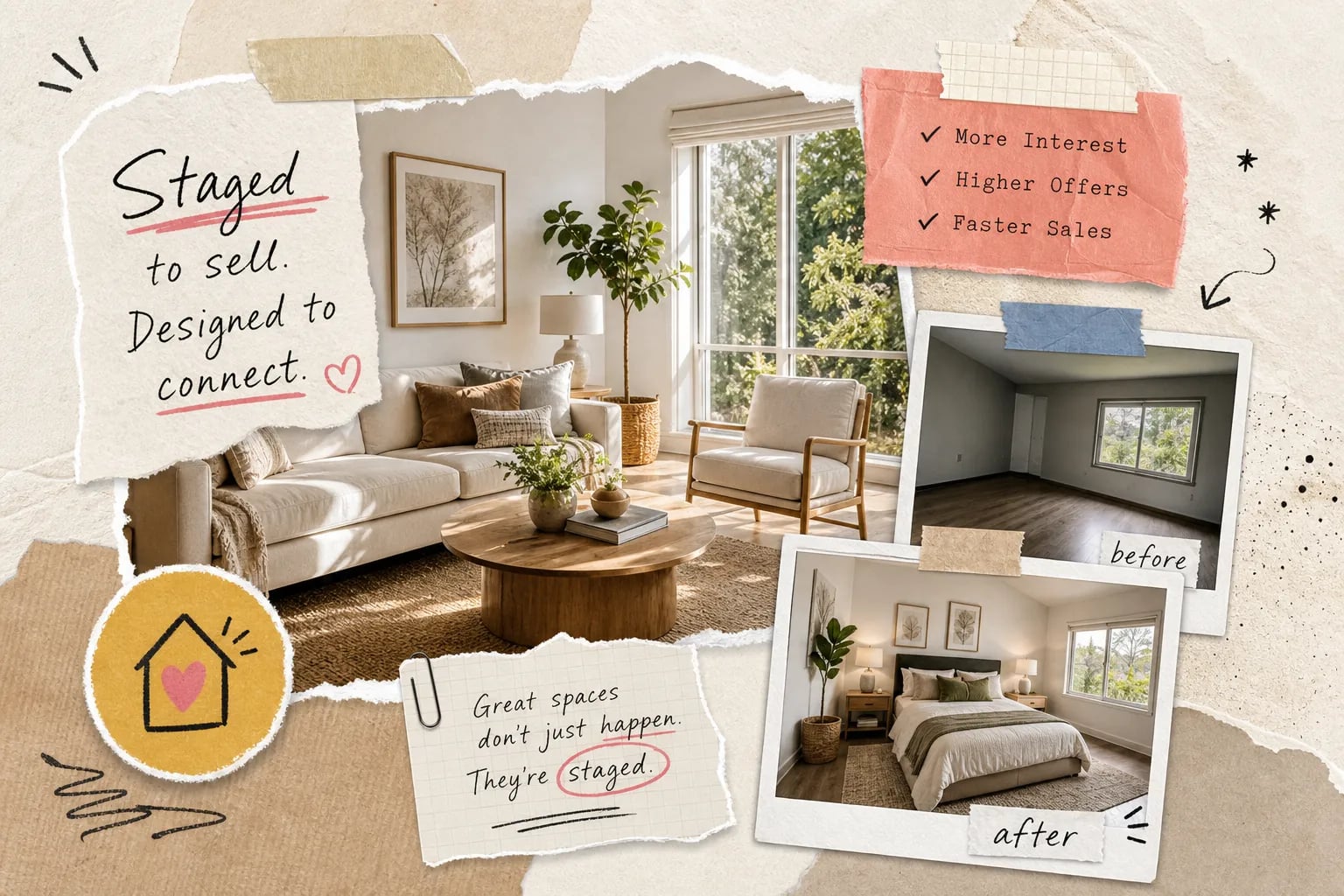
The numbers here are stark: unstaged homes spend an average of 184 days on the market compared to 23 days for professionally staged homes. Staged homes also sell for 5, 10% more than comparable unstaged properties. The reason isn’t magic. Staging bridges the gap between an over-personalized space and the move-in-ready, aspirational environment buyers are mentally shopping for. With a large share of buyers beginning their search online (NAR, 2025), first impressions happen on a screen. Staged rooms photograph differently than lived-in ones, and that difference shows up in click-through rates, showing requests, and offers, a connection well-documented in real estate photography and staging research.
What a full-service studio handles so you don’t have to
This is exactly where Classy AF Interiors comes in. Rather than leaving sellers to debate throw pillow colors, rent furniture from three different vendors, and hope it photographs well, our team manages the entire visual presentation process: furniture sourcing, room layout, curated vignettes, neutral palette selection, and coordination with listing photographers. You don’t make design decisions under deadline pressure. One team handles the full picture from walk-through assessment to photo day.
For sellers preparing to list anywhere in the LA to Palm Springs corridor, professional staging in Southern California typically runs $2,000 to $8,000 depending on home size. Industry data consistently shows that staging recoups its cost through faster sales and stronger sale prices, making it one of the highest-leverage investments a seller can make before listing.
4. Time your listing launch to hit buyers at peak activity
The timing of your listing launch compresses time on market before the first showing ever happens. Two specific decisions matter most: the seasonal window and the day of the week you go live.
The spring window that beats every other season
April through June is the most consistently strong listing window across the data. Buyer activity peaks during this stretch as families try to settle before the school year and favorable weather makes house-hunting appealing. Homes listed in May and June show faster contract timelines across multiple market datasets. If you have any control over when to list, targeting mid-April through early June gives your home its best statistical chance at a quick home sale.
Why Thursday beats every other weekday
The mechanism is simple: buyers who see a new listing on Thursday add it to their weekend viewing plans. A Thursday launch means your home is fresh and at peak algorithmic visibility right when foot traffic is highest, typically Friday evening through Sunday. Listings that go live on Monday or Tuesday can lose momentum sitting mostly unseen before buyers start shopping again. Thursday is the single easiest timing adjustment you can make with measurable impact on early showing volume. Combine it with a spring launch and strong photos, and you’re stacking the odds before a single buyer walks through the door.
5. When a cash offer or iBuyer is actually the right call
Not every seller needs to optimize for maximum sale price. Some need certainty, speed, or the ability to skip repairs entirely, essentially, the option to sell house as-is. Understanding the real cost of both fast-sale alternatives helps you make an honest decision about whether the trade-off fits your situation.
iBuyers typically close in 7, 30 days from offer acceptance, which is genuinely fast. But the full cost picture matters. Service fees usually run 5, 8%, and post-inspection repair deductions often push net proceeds 3, 13% below what an open-market sale would produce. For sellers who prioritize certainty over maximum net, and whose home meets the iBuyer’s property criteria, this can be a reasonable path. For sellers with a well-presented home and a few weeks to work with, a traditional listing almost always yields more money.
Local cash home buyers and investors can close in as little as 7, 21 days with far fewer contingencies than a financed buyer. There’s no appraisal risk, no lender delays, and often no required repairs. The trade-off is that investor offers are typically 10, 15% below what the home would net on the open market. This path makes the most sense for sellers dealing with a distressed property, a time-sensitive relocation, an inherited home, or situations where financing and repair contingencies create deal risk they can’t afford. Know your priorities going in, and the right path becomes clear.
FAQ: How to sell your home faster in 2026
How quickly can a staged home sell compared to an unstaged one?
Staged homes sell significantly faster, industry data shows unstaged homes averaging around 184 days on the market versus roughly 23 days for professionally staged properties. That gap alone makes staging one of the most cost-effective pre-listing investments available.
What’s the fastest way to sell my house fast without sacrificing price?
Price it competitively from the start, stage it professionally, launch on a Thursday in the spring window, and have your listing photos ready before you go live. This combination consistently produces fast contract timelines without requiring you to discount below market value.
Is it worth it to sell home quickly for cash?
It depends on your priorities. Cash buyers and iBuyers close fast, sometimes in under two weeks, but typically offer 10, 15% below open-market value. If speed and certainty matter more than maximizing net proceeds, a cash sale makes sense. If you have time to prepare and list, a traditional sale almost always nets more.
What does professional staging cost in Southern California?
Professional staging in the LA to Palm Springs corridor typically runs $2,000 to $8,000 depending on home size. Most sellers recoup that cost through faster sales and stronger offers, often many times over.
The sellers who close fast in 2026 aren’t necessarily the ones who spend the most
They’re the ones who price strategically from day one, prepare the home visually with intention, launch at the right moment in the calendar, and match their sale path to their actual situation. Speed and net proceeds aren’t always in conflict, the right sequence of decisions gives you both.
For sellers in Southern California who want to sell their home faster with the visual side handled professionally, from staging to photo-ready styling, Classy AF Interiors offers a free consultation to assess what your home needs and build a clear plan. A faster sale starts with a home buyers can fall in love with from the first photo, and that’s precisely what we help you create.
Book your free consultation at Classy AF Interiors and find out what your home needs to go from listed to sold, fast. Learn how today.