Home Staging ROI in 2026: Costs, Returns, and Hard Data
Spending several thousand dollars before you’ve collected a single dollar from your sale feels counterintuitive. Every seller evaluating home staging ROI asks the same question: does this actually pencil out? The honest answer is yes, but the specific return depends on which data source you’re reading, what type of staging you buy, and where your home sits in the market. Those variables matter enormously.
Orange County sharpens this conversation in a particular way. With single-family median prices hovering around $1.425 million and condos trading near $860,000 in 2026, even a modest percentage lift in sale price translates into a real dollar figure that dwarfs what you’d see in lower-priced markets. At Classy AF Interiors, we’ve tracked staging outcomes across years of Southern California projects, and the results from our own work consistently align with, and often exceed, what the national studies report. This article walks through the full picture: what staging costs, what it returns, and how to calculate your expected home staging ROI before you spend a dollar.
Why staging return figures vary so wildly across sources
The reason you see figures ranging from “75% cost recoupment” to “3,551% ROI” in the same Google search is that the two most-cited sources, NAR and RESA, are measuring completely different things. NAR surveys realtors and calculates staging return as a sale price premium over list, typically landing at 1%, 10% above asking for staged homes versus 1%, 5% for unstaged. RESA surveys staging professionals and calculates ROI as the percentage return on the staging fee itself, which produces the eye-catching headline numbers. Neither methodology is wrong; they’re just answering different questions.
What actually matters for a seller is narrower than either headline. Track two numbers: the percentage increase in your net sale price and the reduction in carrying costs from selling faster. The combination of those two figures is your real home staging ROI. Everything else is industry math designed to headline a press release.
In Orange County, the math gets more compelling than the national average simply because of price point. A 2% sale price premium on a $900,000 home is $18,000. The same 2% on a national median closer to $420,000 is $8,400. Staging costs for comparable scopes are often in the same ballpark. That’s why the home staging ROI case is stronger in competitive Southern California markets than it looks when you read national averages.
What professional staging actually costs in 2026
Staging cost breaks down cleanly by scope:
- Partial staging (occupied home, key rooms only): $800, $2,500 nationally
- Full staging (occupied home, comprehensive restyling): $2,000, $6,000
- Vacant home staging (furniture rental, delivery, installation, monthly fees): $2,000, $8,000 or more depending on home size and furnishing density
- Virtual staging (digitally furnished photos only): $100, $500 per listing
A practical budgeting rule is to plan for 0.5%, 2% of your listing price across most staging scopes. Applied to OC price points, that looks like this:
- $700,000 condo: $3,500, $7,000 for full or partial staging
- $1.2 million single-family home: $6,000, $12,000 depending on scope and whether it’s vacant
- $2 million luxury property: $10,000, $20,000, with vacant staging at the higher end
Virtual staging deserves a separate note. The cost savings are real, but it works best in one specific situation: a vacant home where buyers already struggle to gauge scale and layout from empty rooms. The limitation is that buyers still walk into an empty house at the showing, which can undercut the impression the photos created. For most OC sellers competing in a photo-first market, physical staging holds a meaningful advantage at the showing stage.
Virtual staging ROI vs. physical staging
When weighing virtual staging ROI against physical staging, the gap comes down to the showing experience. Virtual staging can lift online click-through rates and help buyers visualize a vacant space, but it doesn’t change what they encounter at the door. Physical staging works on both fronts, it improves listing photos and delivers the lived-in atmosphere that influences in-person offers. For OC sellers at higher price points, the showing-day impression tends to drive the larger return.
Home staging ROI: sale price premiums and days on market
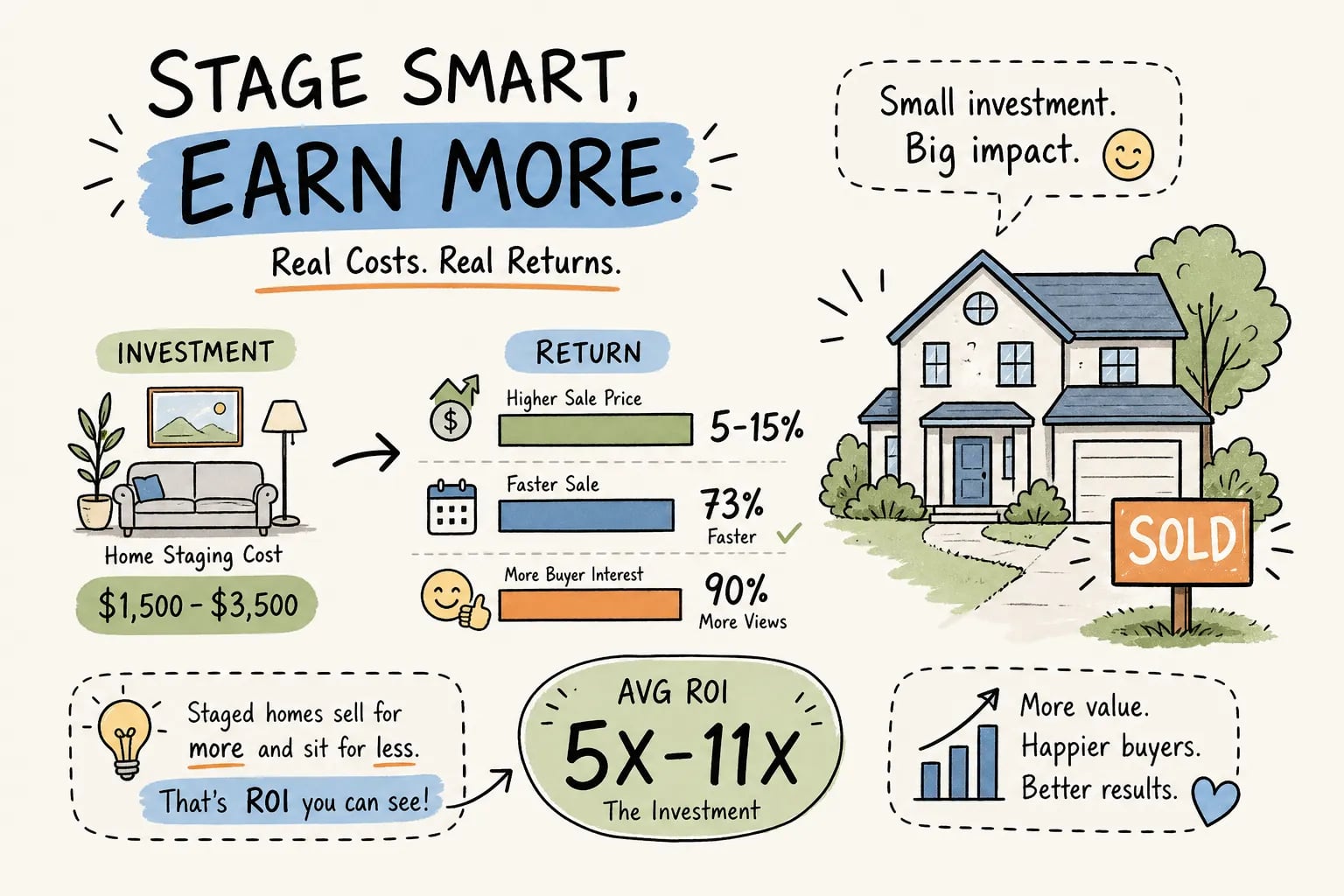
The NAR data on sale price is worth understanding precisely. In a survey of 1,266 realtors, staged homes sold 1%, 10% above list price while comparable unstaged homes sold 1%, 5% above list. RESA’s data from 13,000 staged properties goes further, reporting that 85% of staged homes sold 5%, 23% over asking. The wide range across both sources reflects the reality that property condition, staging quality, and market timing all affect where any individual home lands. What the data establishes consistently is that staging moves the outcome in a positive direction.
Days on market is the ROI multiplier most sellers underestimate. NAR data shows staged homes averaging roughly 23 days on market versus 47 days for non-staged properties, a 51% reduction. RESA’s Q3 2025 quarterly report puts staged homes at 19 days on market with a 109% sale-to-list ratio, meaning staged homes in that sample closed at an average of 9% over asking. The financial implication of faster sales is concrete: every additional month on market in Southern California means another mortgage payment, property tax installment, insurance bill, and growing risk of a price reduction. For a $900,000 home with a 20% down payment at roughly a 6.5% mortgage rate, one extra month of carrying costs runs approximately $6,000, $7,500. That number alone often covers the entire staging investment.
Online listing performance is part of the same equation. According to NAR’s 2025 Profile of Home Buyers and Sellers, more than half of buyers find their home through an online search. Staged listings receive more online engagement, which converts directly into more showing requests in the first week. In a market where the first seven days on MLS determine whether you price-reduce or field multiple offers, that early traffic is not a soft benefit. It’s the mechanism that produces the sale price premiums in the data.
How to calculate your home staging ROI before you spend a dollar
The formula is straightforward: take your estimated sale price increase plus your estimated carrying cost savings from selling faster, subtract the staging cost, divide by the staging cost, and multiply by 100. That gives you your expected percentage return on the staging investment, the same ROI framing used by RESA-style industry reports, which measures return relative to the staging fee rather than as a percentage uplift of sale price.
Sample OC ROI calculation
Here’s how it runs on a real OC scenario. A $900,000 listing, full staging at $4,500, a conservative 3% sale price uplift of $27,000, and three weeks of carrying cost savings from a faster sale worth approximately $5,200. Total return: $32,200. Subtract the $4,500 staging cost; net gain is $27,700. Divide by $4,500 and multiply by 100: roughly 615% return on the staging fee. At Classy AF Interiors, we run this type of projection in client consultations so sellers can evaluate the investment against their specific timeline and price point before committing to any scope of work.
The formula shifts based on staging type. For a vacant home priced above $1 million, the cost-to-uplift ratio typically improves because the absolute dollar return from even a modest percentage premium outpaces the staging fee by a wider margin. For an occupied home in good condition, partial staging of the living room, primary bedroom, and kitchen often produces comparable results to a full staging at a fraction of the cost.
Which staging elements deliver the highest return per dollar spent
Decluttering is the single highest-incremental-return action a seller can take. It costs almost nothing and directly improves perceived square footage and cleanliness, two of the first things buyers assess in person and in photos. Any professional staging consultation will start here before recommending a single furniture piece. If you do nothing else, edit ruthlessly.
Repairs and curb appeal follow closely. Visible maintenance issues are objection machines. Buyers see a dripping faucet or peeling paint and immediately discount their offer or walk away entirely. Fresh exterior paint, updated light fixtures, and basic landscaping consistently rank as high-return improvements because they eliminate mental objections and boost the listing photo click-through rate, which is what gets buyers through the door in the first place.
Full furniture rental and professional styling deliver the strongest absolute returns for vacant homes and higher-priced listings. Empty rooms photograph poorly and make it genuinely difficult for buyers to gauge layout and livability. For occupied homes in reasonable condition, targeted staging of three key rooms, living area, primary bedroom, and kitchen, often matches the return of a full staging at a meaningfully lower cost.
Is staging worth it for your Southern California listing?
For vacant homes, time-sensitive sales, and properties priced above $700,000 in OC and greater LA, the combination of a sale price premium and faster days on market almost always produces a positive home staging ROI. Both NAR and RESA data support this across varying market conditions, and the OC price point makes the absolute dollar math more favorable than what you’d see in lower-priced markets nationally.
If budget is the constraint, sequence your investments. Start with decluttering, basic repairs, and curb appeal. Then model out full professional staging using the ROI formula from the previous section. Sellers with vacant listings or higher-priced homes will almost always find the numbers favor staging when they run the actual math rather than making a gut call on the spend.
The team at Classy AF Interiors offers a free consultation to help OC and SoCal sellers work through exactly this decision, including a personalized home staging ROI projection based on your home’s price point, condition, and target timeline. If you’re preparing to list and want OC-specific staging recommendations before you commit to a scope, that’s the right place to start. Reach out and we’ll run the numbers with you.