
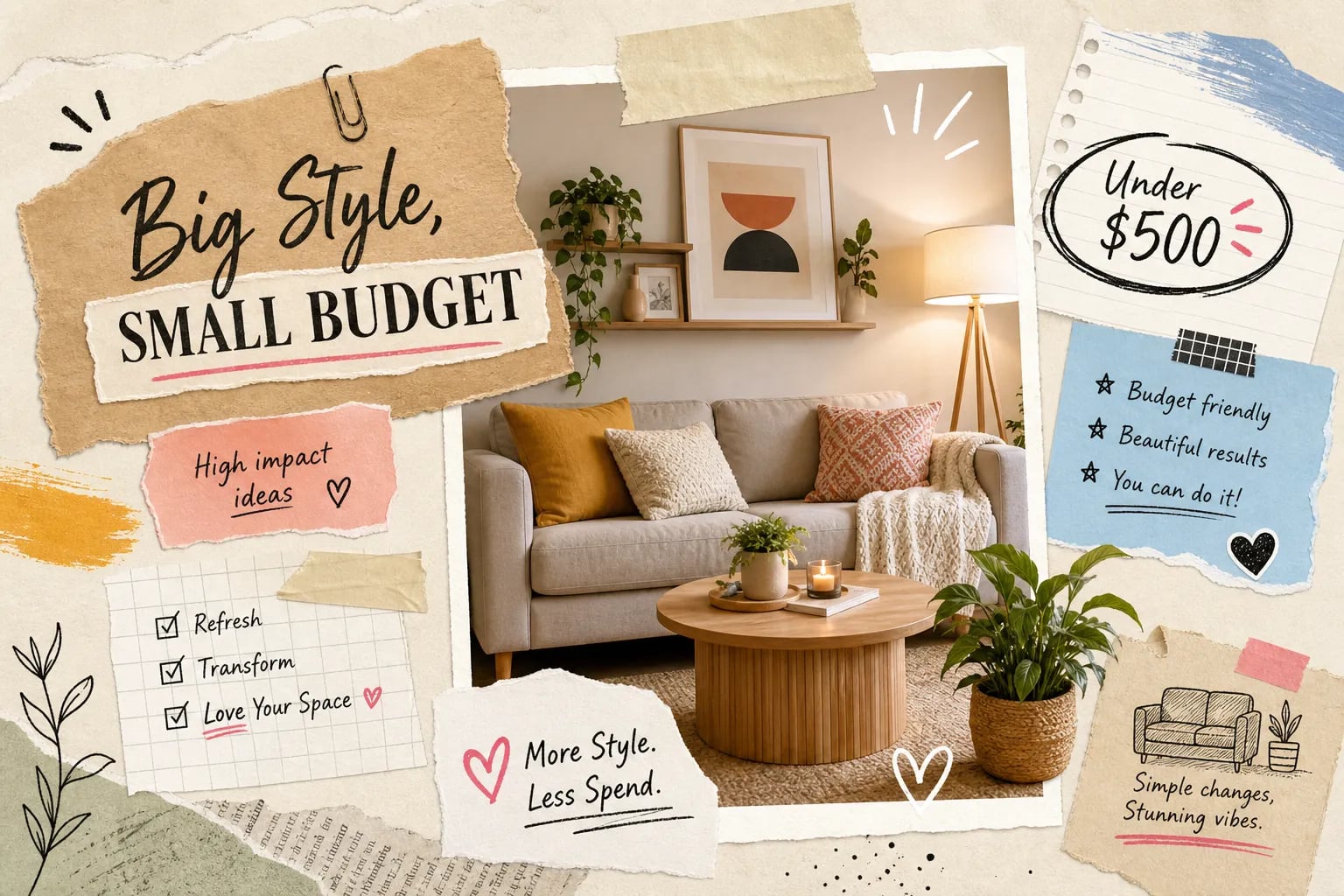
Budget Interior Design: High-Impact Ideas Under $500
Budget interior design isn’t about cutting corners, it’s about spending in the right order. Most decorating projects fall flat not because the budget was too small, but because the money went to the wrong things first. Someone drops $300 on throw pillows and a blanket, then wonders why the room still feels “off.” The room feels off because the lighting is yellowed, the walls are a muddy beige from 2011, and the furniture is floating in the middle of the space with no logic. Accessories can’t fix that. Only the right sequence can.
That sequencing principle drives the “Ballin’ on a Budget” approach at Classy AF Interiors. The Orange County studio built an entire service model around one core idea: professional-looking results don’t require a big budget; they require smart home design choices. Whether you’re refreshing a rental, prepping a home to sell, or just tired of staring at a room that doesn’t feel like you, the process starts in the same place.
This article gives you that process in full, which upgrades to tackle first, realistic cost estimates by room, the best places to source furniture and decor without overspending, and four specific DIY projects you can execute this weekend. Work through it in order and you’ll stretch every dollar further than you thought possible.
The priority rule that makes every budget interior design dollar count
Before you buy a single item, understand why the order of investments matters. Spending $200 on a new lamp in a room with dirty walls and awkward furniture placement is a waste. The room needs a foundation first, and that foundation costs less than most people assume.
Why paint and lighting outperform furniture almost every time
Fresh paint covers the most surface area for the least money of any upgrade in your home. It immediately shifts a room’s color, brightness, and mood. At Classy AF Interiors, paint consistently ranks as the single best return on visual investment, and in Orange County, professional interior painting runs about $3.00 to $6.50 per square foot. DIY cuts that cost but that is the area I do not like to cut corners on especially in high traffic areas like a living room or anywhere in the downstairs/main living area. Always hire a professional!
Lighting changes how every other material in a room reads. Updating a fixture or swapping your current can lights to warm LED bulbs is one of the cheapest interventions available, and the visual payoff is immediate. Together, paint and lighting form the highest-impact, lowest-cost foundation for any budget-friendly home decor refresh.
The free upgrade most decorators skip
Furniture rearrangement and decluttering cost nothing, yet they can transform the perceived size and flow of a room more dramatically than any single purchase. Removing visual noise before adding anything new is the clearest decision a budget decorator can make, think of it as clearing the stage before the performance starts. Follow this sequence: paint, then lighting, then declutter and reset the layout, then everything else.
Budget interior design: high-impact upgrades ranked by visual return per dollar
Once the foundation is solid, you can start adding. But not everything delivers equal returns. The upgrades below are ranked by how much they change the overall read of a room relative to what they cost.
The top four upgrades that change a room’s entire read
- Paint. For the reasons already covered, this is always first. It’s the highest-ROI move in any low-cost room makeover.
- Lighting. Replacing an outdated fixture and installing warm LED bulbs changes how the entire room photographs and feels in person.
- A large-scale mirror or statement art piece. These create a focal point, add perceived square footage, and signal intentional design. A single oversized mirror from IKEA or a large framed print can do more for a living room wall than a dozen smaller pieces combined.
- Cabinet hardware, switch plates, and outlet covers. This upgrade runs under $50 for most rooms and modernizes every surface people touch, which subconsciously reads as “updated” even when nothing structural has changed.
These four outperform decor shopping because they work at a structural level. New pillows sit on top of a space; better lighting and fresh paint change the space itself, that’s the fundamental difference.
Textiles, rugs, and the finishing layer
Area rugs define zones and ground furniture groupings. In a living room, the right rug makes a seating arrangement feel deliberate rather than random, and it’s often the first thing a visitor notices. Curtains hung at ceiling height, not window height, visually raise a room for the cost of a hardware rod and two panels. These are strong performers, but they work best after the four foundational upgrades are in place. Pillows and throws come last. They enhance a room that’s already working; they can’t rescue one that isn’t.
What $250, $1,000, and $2,500 actually get you by room
Vague budget advice is useless. Here’s what each tier realistically covers across the most common rooms people update.
Room-by-room breakdown at each budget tier
At $250, you’re working at the surface level. Think textiles, thrifted decor, a lamp swap, and one small art piece. This budget works best when you pick one focal change per room and commit to it fully. At $1,000, a credible refresh becomes possible. Paint, a rug, curtains, updated lighting, and one small furniture piece can all fit within this number in most rooms. At $2,500, you have room for one real furniture upgrade plus all the foundational changes, enough to meaningfully transform a bedroom or living room if you keep the major existing pieces.
By room, the highest-ROI inexpensive decorating investments break down like this:
- Living room: Rug and lighting carry the most visual leverage. A properly sized rug that fits the full seating zone changes scale and cohesion more than any other single purchase.
- Bedroom: Bedding and window treatments shift the mood fastest and most affordably.
- Kitchen: Paint, cabinet hardware, andpeel-and-stick backsplashdeliver the biggest cosmetic change without touching anything structural. Brands like Art3d, Smart Tiles, and STICKGOO are consistently top-rated and widely available.
- Bathroom: Mirror, lighting, and shower curtain are the highest-ROI trio. For under $300, these three alone can take a dated bathroom to something that looks intentionally designed.
Where to put the money first in every room
Spend on items that affect the most visual surface area or are touched and seen most often. Save on trend-driven accessories that can be swapped inexpensively down the road. A practical allocation guide: soft furnishings and paint should account for roughly 40 to 50 percent of a well-spent refresh budget, with lighting and foundational updates taking another 15 to 20 percent. Decorative accessories come last, not first, and should absorb whatever remains after the room’s structure is working.
Where to shop so your home doesn’t look like a budget
Knowing what to buy is half the equation. Knowing where to source it affordably without sacrificing quality is the other half.
Retailers and online sources worth bookmarking
IKEA remains a reliable source for solid, modern basics at accessible price points. Wayfair offers broad budget selection and runs frequent sales worth timing your purchases around. Target consistently delivers decor and smaller furniture pieces that look significantly better than their price tags suggest. For a more design-forward look without crossing into premium pricing, Article and AllModern are both worth exploring, Article for its quality-to-price balance across sofas and case goods, AllModern for its curated range of contemporary accent pieces.
Thrift, secondhand, and outlet channels that actually deliver
Facebook Marketplace and Craigslist offer the best prices on used furniture, especially sofas and dining tables where retail markups are steep. Estate sales are underrated: quality is often high, particularly for vintage and solid wood pieces, and prices typically run well below resale retail. IKEA As-Is and Wayfair Outlet both carry discounts of 20 to 80 percent on furniture with minor cosmetic issues, worth checking before paying full price.
The practical rule: buy secondhand for large furniture, buy new for anything fabric that touches skin. One well-chosen thrifted anchor piece paired with fresh Target accessories reads as curated. That combination almost never reads as cheap, and it’s one of the smartest moves in budget-friendly home decor.
Four DIY projects worth doing this weekend
Theory only goes so far. These four projects are executable now, and each one has a high finish-to-effort ratio.
Gallery walls and peel-and-stick backsplash
A gallery wall runs $30 to $300 depending on frame count and art sourcing. The key to making it look designed rather than accidental: lay the entire arrangement on the floor before touching a nail. Adjust spacing and composition until it’s right, then transfer to the wall using paper templates or painter’s tape. Printing art at home cuts costs significantly. A mix of one or two larger pieces with smaller ones avoids the expense of buying many frames while still creating real visual weight.
Peel-and-stick backsplash covers a kitchen or bathroom wall for $50 to $400 depending on the area and brand. The installation requires no grout, no tile tools, and no professional help. Clean the wall thoroughly first so the adhesive bonds, dry-fit the sheets before peeling, and smooth out air bubbles as you go. The result looks like a designer decision, nothing about the process reveals it as a weekend DIY.
Lighting swaps and furniture upcycling
Swapping a dated ceiling fixture costs $30 to $200 including bulbs and delivers one of the strongest visual returns of any weekend project. Turn off the breaker, confirm with a voltage tester, match the wiring, and mount. That’s the full technical scope. If the existing base is in good shape, replacing only the shade or globe cuts the cost further. A sputnik or globe pendant under $100 at Home Depot or Wayfair can make a dining area or bedroom feel completely redesigned.
Furniture upcycling runs $15 to $50 per chair seat for a fabric refresh, and $30 to $150 for a painted and re-hardwared side table or cabinet. Sand, prime, paint in thin coats, and swap the hardware. What comes out the other side looks purchased, not found. The realistic total for all four projects together lands between $195 and $700 depending on scope and what you already own. Stocking a basic toolkit, tape, rollers, staple gun, utility knife, makes every future project faster and cheaper.
When a pro makes your budget go further
There’s a point where the trial-and-error cost of going it alone exceeds what professional guidance would have cost. Buying a rug that’s the wrong size, a paint color that looked different on the swatch, or a sofa that doesn’t fit the room’s scale are all expensive mistakes. A single design consultation that steers you away from those calls often pays for itself before you’ve spent a dollar on product.
What the “Ballin’ on a Budget” design approach actually looks like
At Classy AF Interiors, the entire design practice is built on the principle that professional-looking spaces require smarter priorities, not bigger budgets. The studio’s process starts with the same impact-per-dollar framework covered in this article, then applies it with professional-level sourcing connections and spatial instincts that take years to develop. For sellers and investors across Southern California, that same approach drives their home staging work, transforming listings from Los Angeles to Palm Springs without over-investing in a space the client won’t be living in.
How to start without committing to a full project
Classy AF Interiors offers a free consultation for new clients. No commitment, no design jargon, no pressure. It’s the right fit for homeowners who want to refresh on a real budget, investors who need fast turnarounds, and sellers who want to maximize their listing without a full renovation. You walk away with a clear, prioritized action list for your specific space. Book your free consult at ClassyAFInteriors.com and walk away knowing exactly where to start.
Start with one thing this week
Decorating on a budget is a sequencing problem, not a spending problem. The homeowners who get the most out of a limited budget aren’t the ones who find the cheapest prices, they’re the ones who spend in the right order. Paint and lighting before pillows. Layout before accessories. Foundation before finish.
Pick one project this week: repaint a room, swap a light fixture, or spend an afternoon rearranging furniture and clearing what doesn’t belong. Any one of those three changes costs less than most single decor purchases and delivers more visible improvement than all of them combined. Start there, and build from that momentum.
Smart budget interior design is within reach for anyone willing to make decisions in the right sequence. And if you’d rather skip the guesswork entirely, the team at Classy AF Interiors is one free conversation away.
Frequently asked questions about budget interior design
How do I do budget interior design in a rental?
Focus on changes that don’t require permanent alterations: peel-and-stick backsplash, removable wallpaper, freestanding furniture, and swapped-out light fixtures (save the originals to reinstall). Paint is often allowed with landlord approval, it’s worth asking, since it’s the single highest-impact upgrade available. Rugs, curtains, and gallery walls using damage-free hanging strips round out a strong renter-friendly approach.
What is the most cost-effective room to update first?
The living room typically delivers the highest return per dollar because it’s the most visible space in a home. Prioritize a properly sized rug, updated lighting, and a single focal-point piece. If you’re preparing to sell, the primary bedroom is a close second.
How do I make a room look expensive on a small budget?
Stick to a tight, cohesive color palette. Hang curtains at ceiling height. Use one large mirror to add depth. Replace builder-grade hardware on cabinets and doors. These four moves cost under $200 in most rooms and are the core of any effective affordable interior design strategy.
Is it worth hiring an interior designer on a tight budget?
A single consultation, especially one that prevents a costly mistake like the wrong rug size or an off-scale sofa, often costs less than the error it avoids. Studios like Classy AF Interiors offer free initial consultations specifically for clients working within real budget constraints.
